


Fifth Generation Cellular for RVers and Boaters
 5G is shorthand for "fifth-generation" cellular technology.
5G technology, developed over several years, started to go mainstream in 2020 and is continuing at a rapid pace of growth.
5G is now the mainstream technology for new devices and most current plans in North America and much of the world. LTE remains widely deployed and important, but carriers are increasingly shifting growth and capacity toward 5G.
As 5G expands, it is evolving toward 6G - the next major technology leap expected to arrive around 2030.
In this guide, we will explain 5G and how it affects RVers and cruisers who rely on cellular data for their mobile internet needs.
We actively update this guide and all of our content to keep up with this rapidly evolving technological shift.
This guide covers 5G technology at a high level. We also have related guides that go into more detail, as well as our news stories and industry updates:
If you're a member, please log in above to see your exclusive content.
Don't need a membership? Other ways you can support our work here:
-
As seen in our videos!
-
Get a FREE Month of Starlink!
And our team will get one too!
-
Get a FREE Month of T-Mobile Unlimited Data
Join the Calyx Institute, and get a bonus month - and we do too!
-
Save $20 on Visible
Verizon's prepaid phone plan, we also get a $20 credit.
-
Share About Us!
Link to our content, tell others about MIRC. It's Free!
-
Shop at MobileMustHave
Our members save 10%!
It is with huge gratitude to our members for making the free unbiased educational content on our site possible.
Our members get exclusive access to our in-depth content, classrooms, vendor discounts (that can save you more than membership!), alerts, insider info and interactive guidance. They can even book private advising sessions.
If mobile internet is an important part of your lifestyle, consider helping make MIRC possible by joining or supporting our mission.
What is 5G?
Roughly every ten years, a fundamentally new generation of cellular technologies comes to market.
In 2010, the 4G/LTE era began when Verizon became the first United States carrier to embrace fourth-generation cellular technologies, moving from the limited mobile data capabilities of the 3G era towards the data-centric speeds and capabilities enabled by 4G.
Then, in 2020, this process was repeated with 5G technologies that built on LTE and substantially improved cellular connectivity.
Why Evolve via Generations?
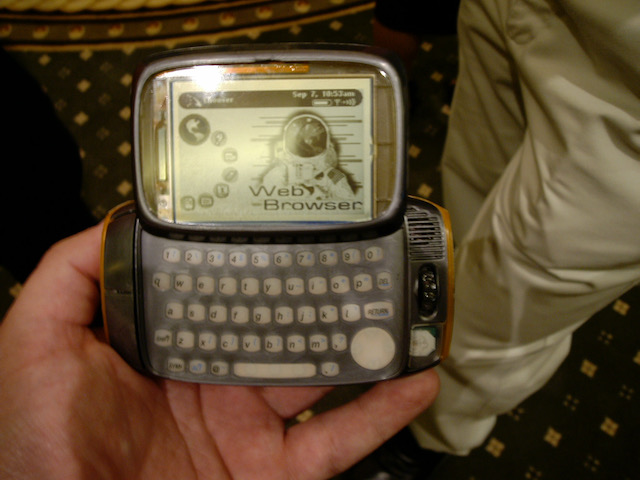
Cellular technology is based on common technical standards, which allow different device manufacturers, cellular carriers, and networking equipment suppliers worldwide to build interoperable gear.
If it weren't for standards, there would be chaos in the market.
But technology constantly evolves, and so do standards. The standards developed for the technologies available in the 1990s could never have anticipated the technological advancements and market demands of the 2020s.
To strike a balance between interoperability and progress, the cellular industry collaborates to enable a major change in the fundamental underlying standards once a decade, with smaller (but still backward-compatible) updates made every few years between major generational shifts.
The changes across different generations of cellular technologies involve redefining how cell towers and devices communicate, enabling new gear to be developed to those specifications.
In other words, evolving standards to leverage newer technologies enable a new generation of more advanced devices.
A Highway Analogy
Think of the evolution of 2G to 5G (and eventually 6G) like a road system. 2G was like a small winding dirt road suitable for early cars and horses. Today, 5G is like a smart multi-lane freeway with express lanes and priority passes. Newer devices and networks take advantage of the smart freeway, while older ones have to stay on the frontage roads or be put out to pasture.
As technology advanced, the standards advanced - and the overall capability of the highway system evolved.
Cellular is evolving similarly, but at a MUCH more rapid pace!
For more on the past and to better understand the evolution of cellular technology, check out our guide looking deeper into the colorful history of cellular technologies:
Cellular Evolution - From 2G to 6G
Benefits of 5G
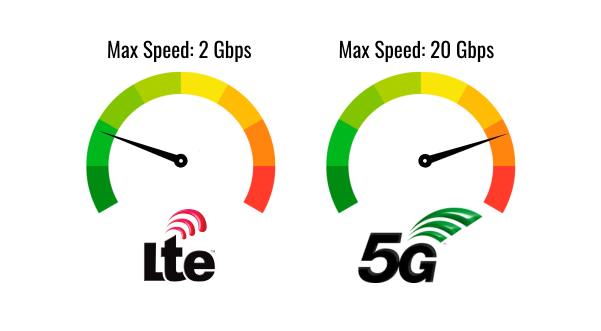
Fifth-generation cellular rethinks cellular networking to enable much higher peak speeds, greater data usage, substantially lower network latency, and vastly more connected devices than were possible in the 4G era.
Some examples of the capabilities that are changing thanks to 5G:
- Faster Speeds: The largest 4G channels are 20 MHz wide (think of them as a 20-lane highway), and carrier aggregation technology allows the most advanced 4G/LTE modems to combine up to 8 different channels for greater capacity. This has enabled peak theoretical LTE speeds to exceed 1 gigabit per second, but it is the limit of 4G technology. 5G technology, on the other hand, allows for 100 MHz and even 400 MHz wide channels (imagine 100 lanes of traffic on a highway!). Even more of these channels can be bonded together, and 5G radios can use these invisible airwaves more efficiently, too. These technological advancements combine to open the door to peak theoretical 5G speeds of over 10 Gbps (gigabits per second) - with multi-gigabit real-world speeds. When 5G is fully developed, peak theoretical speeds should reach near 20 Gbps.
- More Data Usage: Few people can tell the difference between 50 Mbps and 500 Mbps (Megabits per second) for most applications. However, a faster network has the raw capacity to serve more data to more people at once, resulting in less overall congestion.
- Lower Latency: 4G/LTE networks have significant built-in overhead, making it nearly impossible to achieve latencies (the round-trip delay in the network) of less than 30ms. 5G networks are redesigned to enable much lower latencies, enabling cellular to compete with cable and fiber networks.
- More Network Capacity: Not every device needs crazy-fast speeds or low latency. 5G networks are being designed to enable millions of low-cost, lower-performance devices—all connected at once in a way that would have overwhelmed 4G networks. Imagine cellular devices as basic as temperature sensors in a garden, with batteries that last for years without a recharge. 5G allows the network to handle many times more of these types of devices than before.
- Better Battery Life: 5G standards focus on improved efficiency, which translates into better battery life, all else equal. Those power savings allow newer smartphones, for example, to support higher-resolution screens and faster processors.
Though 5G changes the networking rules in substantial ways, it is a direct evolution of 4G/LTE technologies, building on an established foundation.
5G networks are already evolving well beyond LTE, offering performance and features that were not possible with LTE.
5G is fully mainstream, but LTE will continue for many years to come while declining.
5G is still evolving, but it takes time for networks and devices to catch up fully to where standards are. It is important to remember that while the 5G standards enable incredible advancements, it will take time for all these benefits to actually reach the world.
The first generation of 5G devices is already obsolete, and the current generation will eventually phase out too.
2025 Cellular Mobile Internet Update
Refer to our Late 2025 Cellular Industry Update & Guidance - for all of our latest guidance. Here's also our 3-part video series going over the relevant points:
5G Frequencies
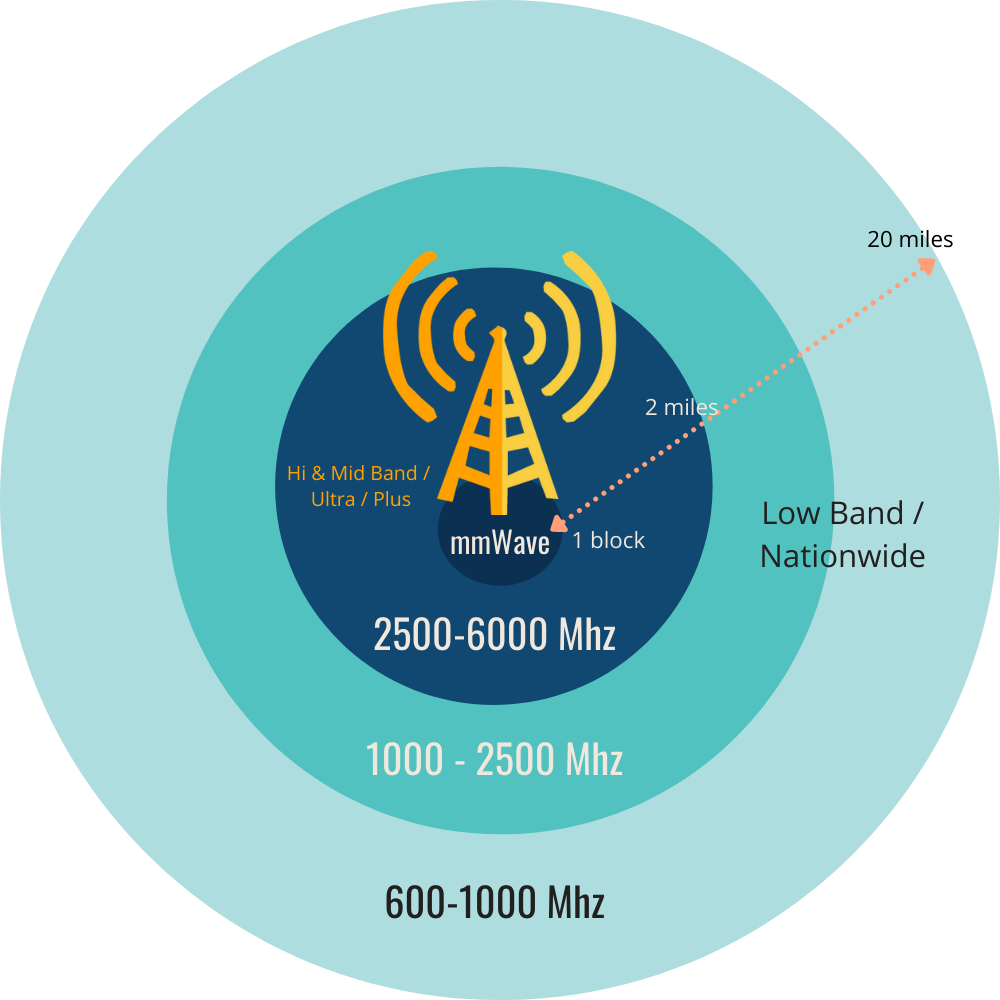
Delivering on the promise of 5G requires new radio technologies and new chunks of wireless spectrum to broadcast upon.
5G is opening new frequency bands and reutilizing existing lower and mid-range bands used by 4G/LTE and retired 3G networks.
These frequency bands have distinct performance characteristics and are grouped into three types: mmWave (millimeter-wave), mid-band, and low-band.
You can think of these as layers in a cake. Each is part of the cake but has unique flavors and characteristics.
Each carrier approaches its 5G deployments differently, depending on its spectrum holdings and other factors. Most carriers are focusing on mid-band frequencies, which provide a good balance of speed and range.
To find out where the carriers are currently at and what bands they support, see our Major Carriers Guide.
Here is more about the layers of the 5G frequency cake:
mmWave
These super high-frequency signals are great for speed, but they do NOT travel far through the air, and walls and windows can easily block them. This means that mmWave 5G networks only provide 5G service within a block or so (or even less) of the typically streetlight-mounted mmWave 5G transmitters. This mmWave technology is excellent for delivering 5G service in places where many congregate - like stadiums, city centers, airports, and shopping malls - eliminating dreaded network congestion.
Many of the earliest 5G deployments focused on extremely high-frequency millimeter-wave (mmWave) signals. mmWave will rarely be the type of 5G that RVers and cruisers will encounter since it is deployed in dense urban areas.
With mmWave coverage, speeds are expected to be measured in Gbps.
Mid-Band
This spectrum provides a good balance of speed and range, and it's considered the sweet spot. It's the key to a truly "next-generation" 5G experience.
Many of the mid-band frequencies use new spectrum that carriers are still deploying, so this is the fastest-changing area of 5G.
With mid-band, anticipate speeds in the hundreds of Mbps and coverage extending a few miles from the towers.
Low-Band
This spectrum is already largely used by carriers for their 4G/LTE networks today, and is being repurposed to provide 5G over long ranges. Additionally, some frequencies previously used for 3G are being repurposed for 5G.
Low-band 5G can reach most anywhere 4G/LTE is available today, providing nationwide 5G even in rural locations. But this low-band, long-range 5G technology can not defy the laws of physics - and if you are only in a low-band coverage area, 5G will not be able to deliver performance much beyond "really good 4G" in many places.
Early low-band 5G often used DSS (discussed later in the guide) or small dedicated slices alongside LTE. As 5G standalone and mid-band coverage mature, carriers are gradually shifting some LTE capacity to 5G. Eventually, LTE will be retired like 3G was.
For more on understanding the trade-offs of different cellular frequencies, check out our guide:
Understanding Cellular Frequencies
5G Indicators
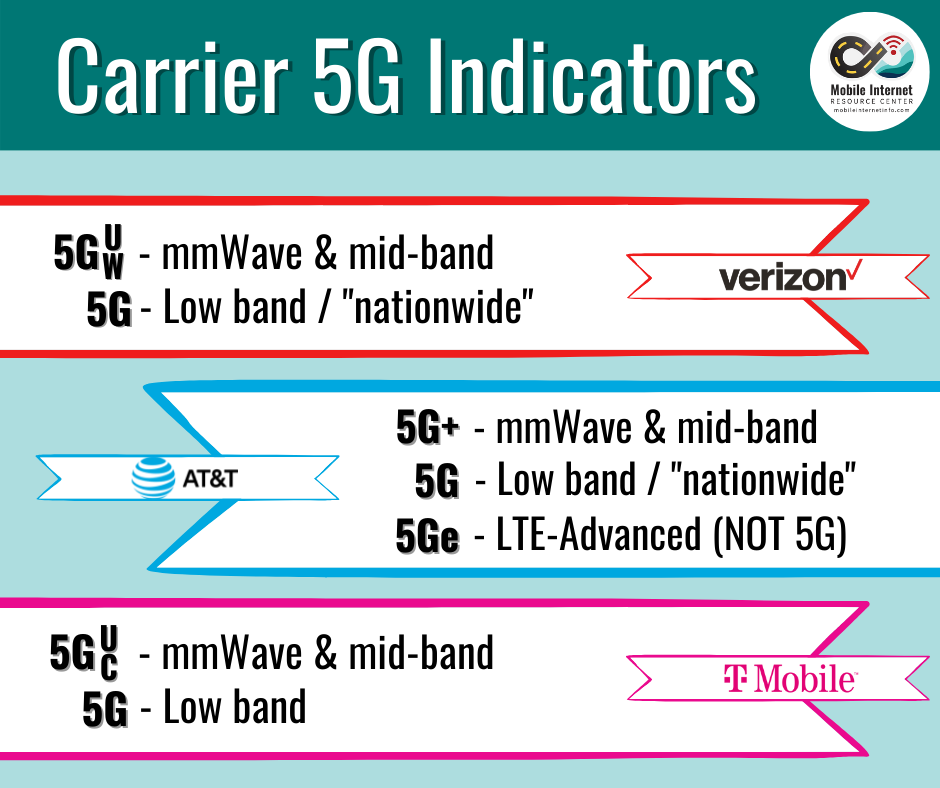 Each carrier takes a different path to fully deploy its 5G networks. While each carrier has a single, large network that devices connect to, they have subdivided some of the layers in the cake into service tiers in their marketing and data plans.
When connected, your device will show what type of 5G you are currently connecting to. Unfortunately, these are not standardized across all carriers.
Here's how the carriers are labeling their 5G flavors, which are explained in greater detail in the "5G Race" member section below:
Verizon
- 5GUW - mmWave and mid-band spectrum
- 5G - Low-band / "Nationwide" 5G
AT&T
- 5G+ - mmWave and mid-band spectrum
- 5G - Low-band / "Nationwide"
- 5Ge - LTE-Advanced (NOT 5G, despite the label!)
T-Mobile
- 5GUC - mmWave and mid-band spectrum
- 5G - Low-band 5G
A 5G, 5G+, 5G UW, or 5G UC icon indicates which class of network your device is using, not the speed you will get. Actual performance depends on the band, signal quality, tower congestion, plan priority, modem/antenna setup, and other factors.
Member Exclusive Content Below
Member Exclusive Content In This Guide
Has this guide been helpful so far?
Well.. there's a lot more below available to our members. As well as dozens of other guides like this, videos, classrooms, forums, webinars and more. All specifically created for helping keep RVers, cruisers and nomads online.

Consider Becoming a Member
If mobile internet is an important part of your lifestyle, a membership can help keep you connected with these exclusive benefits:
- in-depth exclusive content
- interactive guidance
- vendor discounts
- alerts & insider tips
- classroom
- community
Free Content Like This Made Possible By Our Members!
We are community funded via our premium membership program - allowing us to focus on creating unbiased quality, in-depth, constantly updated content. We don't accept 3rd party advertising, we're not sponsored and we don't sell 'stuff'.
Already a member?
Log in to continue with this guide.
Check out the Topics Covered in the Member Section:
Dynamic Spectrum Sharing
We discuss how 5G cooperates with the existing 4G network and spectrum, allowing a much smoother transition from 4G/LTE to 5G, and explain how and when this will affect mobile users.
Standalone vs Non-Standalone 5G
The first wave of 5G networks is mostly layered on top of existing 4G networks, but eventually all 5G networks will operate standalone without requiring 4G assistance, providing significant benefits. We explain the details in this section and why it's a factor to consider for mobile users.
Fixed vs Mobile 5G
Not all 5G is intended for mobile usage, and many 5G devices (and data plans) are targeting fixed-location installations to compete with cable and fiber internet. We discuss the important differences in these approaches and how they might be useful for nomads.
5G Cellular Gear
5G requires carriers and consumers to upgrade their gear for compatibility. This section discusses 5G compatibility with modems, antennas, and boosters, and focuses on the key technologies and gear to look for.
5G Data Plans
Here, we summarize how 5G affects legacy and grandfathered data plans, examine the current 5G data options, and anticipate the future. We also go into greater detail on how each carrier categorizes 5G access for data plans.
The 5G Race
All carriers are actively and competitively deploying 5G. In this section, we chronicle where Verizon, AT&T, T-Mobile, and Dish/Boost are in the race and explain which carriers are best positioned for 5G now and in the future.
Is it Time to Embrace 5G?
5G has been out for a few years now. In this section, we provide our analysis and advice on whether to jump into 5G and what factors nomads should be aware of.
Is It Time To Embrace 5G?
Yes!
After years of the major carriers pushing 5G as "the next big thing," 5G is now the mainstream option. The carriers hardly mention LTE anymore, except in the fine print, and they are starting the process of refarming LTE spectrum for 5G. This means that from now on, 5G will only improve, while LTE will diminish.
5G is now a mature technology with well-developed network and device support, and good and growing coverage and speeds.
If you were waiting to jump onto 5G, there is no reason not to consider it now.
Current 5G Recommendations
If you're specifically looking for a cellular-embedded 5G router, models with an X62/X65 modem generation should be the minimum. Avoid the X55 and earlier modems.
If you were an early adopter and have gear that uses an X55 modem, consider an upgrade, especially if you use the AT&T or T-Mobile networks. Verizon's network will still work fine with the X55 until they start getting more dedicated low-band 5G.
Anything earlier than the X55, however, is long obsolete, and the X55 is on the road to obsolescence.
4G/LTE Has Peaked And Will Slowly Decline
4G/LTE will be around for years, but with shrinking capacity.
With 5G SA now nationwide at AT&T and broadly at Verizon, and T-Mobile leading in mid-band coverage, all three are refarming LTE spectrum to 5G. T-Mobile is the most aggressive: leaked guidance shows LTE capacity tapering to a 5 MHz “lifeline” by ~2028 with an expected shutdown of LTE around 2035.
LTE devices will continue to work for many years, especially basic phones, but expect less LTE bandwidth for data and shrinking coverage over time as carriers prioritize 5G.
Concluding Thoughts
5G has developed to the point where it is no longer the domain of early adopters and bleeding-edge geeks. It is now the mainstream cellular technology and should be considered the default option when buying new gear.
But 5G isn't done evolving, and cellular carriers still have far more work to do to expand their 5G coverage, especially capacity.
It is very important to be aware of the capabilities of the 5G device you buy to ensure it has a cellular modem that will be relevant in the future.
If you were waiting to jump onto 5G, there is no reason not to consider it now.
Additional Reading
Related Guides
Explore the Resource Center
Have Questions?
Join our 'Library Desk':
Internet for RVers & Cruisers Facebook Group
We cross post news articles and guides, and can help point you in the right direction to our content here on the resource center.
It is with gratitude to our premium members that we're able to offer our free content - and for that, they also have access to our member Q&A areas for more in-depth guidance.
Become a Member
 The MIA is our premium membership - designed for those who consider mobile internet an important part of their lifestyle.
In thanks for making content like this possible, we offer a bunch of additional perks. From interactive guidance, in-depth member exclusive content, discounts, alerts, classroom and ability to book private advising sessions.
Stay In the Know
We're constantly tracking the industry and analyzing new developments for mobile travelers. If you'd like to receive updates, we offer several ways:
- Subscribe to our free monthly newsletter
- Subscribe to our News Stories RSS Feed
- Subscribe to our YouTube Channel
- Follow our Facebook Page



 Mobile Internet Resource Center was founded by Chris & Cherie of